
The Role of Welding in Infrastructure Development

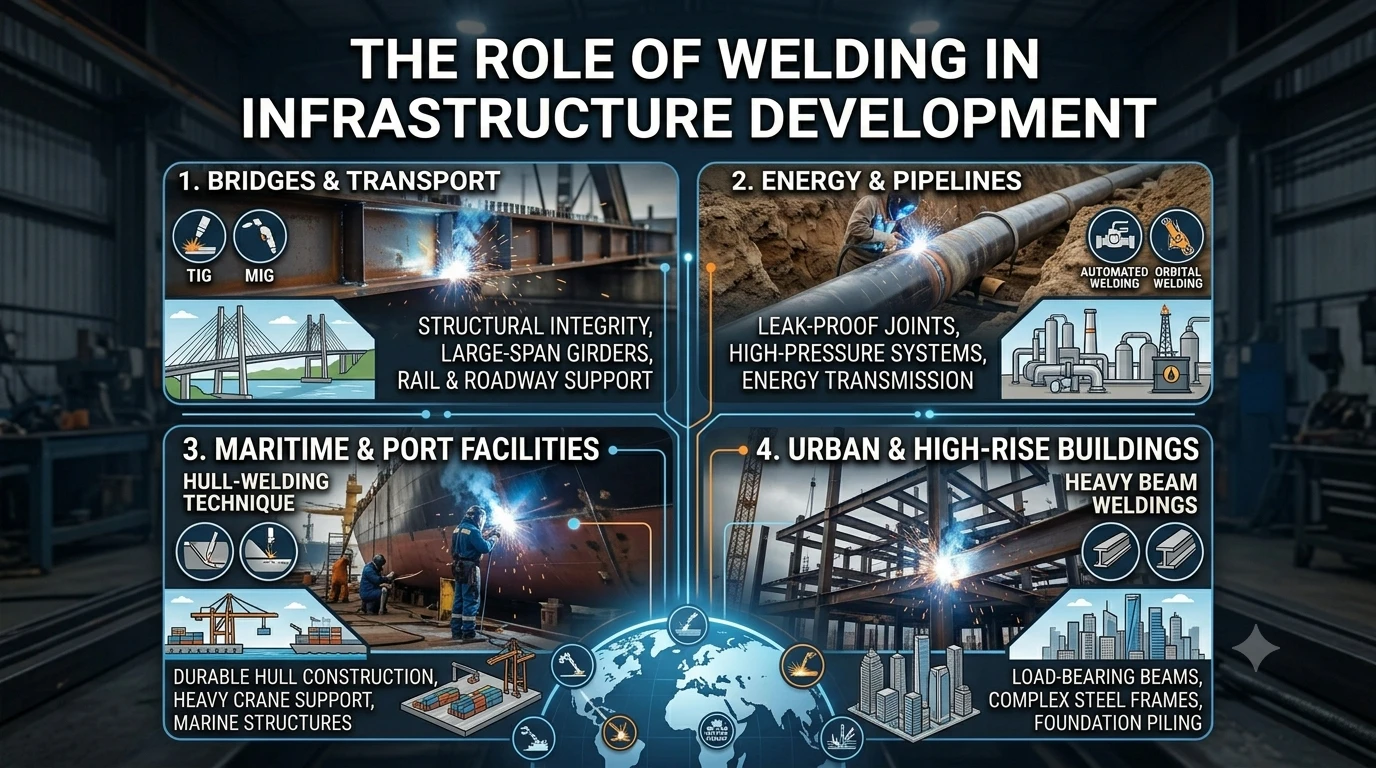
Introduction to Welding and Infrastructure
Welding is a fundamental process in the construction and maintenance of various infrastructures, playing a critical role in ensuring the quality and integrity of structures. At its core, welding involves the fusion of materials, typically metals or thermoplastics, through the application of heat, pressure, or a combination of both. This process is essential for creating strong connections between components, which are vital in building durable structures.
The significance of welding in infrastructure projects cannot be overstated. From the construction of highways and bridges to the assembly of industrial plants and skyscrapers, welding helps to create essential components that contribute to the overall safety and functionality of these structures. In fact, many infrastructure projects rely heavily on welding to ensure that components are securely joined and can withstand varying loads and environmental conditions over time.
Various welding techniques are used within the industry, each suited for different applications. Common methods include arc welding, gas welding, and resistance welding, among others. Arc welding, for instance, utilizes an electric arc to generate heat for melting the base metal along with a filler material, creating a strong bond. Gas welding, which involves the combustion of gases to produce heat, is often employed for smaller or intricate applications. In contrast, resistance welding uses electrical resistance to generate heat and bond materials together, making it particularly effective for thin-sheet metal applications.
This foundational understanding of welding highlights its indispensable role in infrastructure development. As engineers and construction professionals continue to innovate and enhance welding techniques, the resilience and longevity of our infrastructure will improve, ultimately benefiting society as a whole.
Key Welding Techniques Used in Infrastructure Projects
Welding is a critical component of infrastructure development, providing strong, reliable connections in various construction applications. Among the diverse welding techniques, several stand out due to their unique advantages and suitability for specific materials and project requirements.
One of the most prevalent methods is Arc Welding. This technique employs an electric arc to generate heat, fusing metals together. It is widely used in large structural projects, such as bridges and buildings, due to its versatility and effectiveness on thick materials. The ability to work in various positions and its cost-effectiveness make arc welding a go-to choice for many construction teams.
Another commonly employed technique is MIG (Metal Inert Gas) Welding. This process is known for its speed and ease of use, making it suitable for high-volume welding tasks often found in commercial construction. MIG welding is particularly favorable for joining thin sheets of metal, which are prevalent in infrastructure development. The continuous wire feed allows for a steady arc, reducing the time required for completion without sacrificing quality.
TIG (Tungsten Inert Gas) Welding is another significant technique, characterized by its precision and control. This method is ideal for projects that demand exceptional quality, such as pipelines and critical structural components. TIG welding allows welders to work on a variety of metals, including aluminum and stainless steel, making it valuable in diverse infrastructure contexts. Although it requires more skill and is slower compared to MIG welding, the resulting welds are often cleaner and more precise.
In addition to these methods, other welding techniques like Submerged Arc Welding (SAW) and Electron Beam Welding are also utilized in infrastructure, particularly in specialized applications requiring deep penetration or high precision. Each technique offers distinct advantages tailored to specific construction demands, demonstrating the adaptability of welding in the ever-evolving field of infrastructure development.
Economic Impact of Welding on Infrastructure Development
Welding plays a pivotal role in the economic landscape of infrastructure development. As one of the core processes in constructing significant infrastructure projects such as bridges, roads, and buildings, effective welding practices contribute to substantial cost savings and time efficiency. These advantages are critical, given the ever-increasing demands for rapid infrastructure development to support expanding urban populations and economies.
The quality of welding directly influences the durability and safety of infrastructure. High-quality welds reduce the likelihood of defects, which can lead to costly repairs and delays down the line. For instance, a study by the American Welding Society indicates that well-executed welding can result in a 25% reduction in maintenance costs over the lifespan of a structure. This statistic underscores welding not only as a means of construction but as a strategy for long-term economic sustainability in public and private investment projects.
Moreover, welding technology has evolved significantly, allowing for faster and more efficient construction processes. The implementation of advanced welding techniques such as robotic welding has been shown to reduce project timelines by upwards of 30%. This reduction enables projects to be completed quicker, which not only meets essential deadlines but also generates faster returns on investment for stakeholders. For example, the construction of the San Francisco-Oakland Bay Bridge utilized cutting-edge welding methods that facilitated a swift completion schedule, contributing to significant economic benefits for the surrounding region.
Lastly, the impact of welding on job creation cannot be overstated. As infrastructure projects expand, the demand for skilled welders increases, fostering job opportunities and stimulating local economies. This cyclical relationship between welding practices and economic growth highlights the integral role that welding plays in advancing infrastructure development while ensuring overall project viability.
Future Trends in Welding for Infrastructure Innovation
The welding industry is on the brink of substantial transformation as it adapts to emerging technologies that promise to enhance infrastructure development. Automation in welding is expected to play a pivotal role in this evolution. Automated welding processes offer a range of benefits, including improved precision, increased efficiency, and a reduction in labor costs. This advancement is particularly crucial for large-scale infrastructure projects where consistent quality and speed are paramount.
Robotics in welding is also gaining traction. Robotic welding systems can perform complex tasks that are difficult or dangerous for human welders, including working in confined spaces or at high altitudes. These robotic solutions are equipped with advanced sensors that allow them to adjust their technique in real time, thereby improving weld quality and minimizing errors. As such, the integration of robotics into welding operations is likely to enhance both productivity and safety in infrastructure projects.
Furthermore, advancements in materials science are leading to the development of new construction materials that require specialized welding approaches. High-strength alloys and composite materials offer significant advantages in terms of weight and durability, but they also necessitate innovative welding methods to ensure strong joints. This evolution in materials will challenge welders to acquire new skills and adapt their techniques to meet these changing demands.
Finally, eco-friendly welding methods are emerging in response to increasing environmental concerns. Techniques that utilize less energy or produce fewer emissions are becoming more prevalent, reflecting the construction industry’s growing commitment to sustainability. Tools such as laser welding and friction stir welding provide environmentally friendly alternatives that contribute to greener infrastructure practices.
Overall, the future of welding within the context of infrastructure development is poised for significant advancements. The integration of automation, robotics, new materials, and eco-friendly practices will not only reshape the welding landscape but will also lead to enhanced safety and improved outcomes across infrastructure projects.