
Different Types of Welding Processes Explained

Introduction to Welding Processes
Welding is an essential manufacturing process that involves joining materials, typically metals or thermoplastics, through the application of heat, pressure, or both. This technique plays a pivotal role across a multitude of industries, including construction, automotive, aerospace, and manufacturing, where strong and durable connections between components are necessary for structural integrity and operational efficiency. Understanding the various welding processes is crucial, as each method has its unique characteristics, advantages, and applications.
The fundamental principles of welding revolve around the melting of base materials and their fusion into a single coherent structure. This is achieved by selecting suitable welding techniques that align with the material properties and the desired outcome of the joint. For example, some processes may be better suited for thinner materials, while others excel in creating strong joints in thicker substrates. Familiarity with these processes enables engineers and technicians to make informed decisions about the most appropriate welding method for a specific application.
The necessity for understanding these different welding techniques extends beyond the process itself; it encompasses safety measures, equipment requirements, and the skills needed to effectively execute the task. Each welding process requires varying degrees of training and expertise, which can influence productivity and quality in manufacturing environments. Additionally, certain industries may demand adherence to specific standards and regulations, making it critical for professionals to possess knowledge of the nuances associated with each welding technique.
Overall, welding is more than just a means of joining materials; it is a sophisticated art and science that supports the backbone of modern manufacturing and technology. A comprehensive understanding of the different welding processes lays the groundwork for exploring the specific techniques in detail, which will follow in the subsequent sections of this blog post.
Common Types of Welding Processes
Welding is a crucial process in the manufacturing and construction industries, with several different methods available, each suited for specific applications. Understanding the common types of welding processes can help professionals choose the most effective technique for their projects.
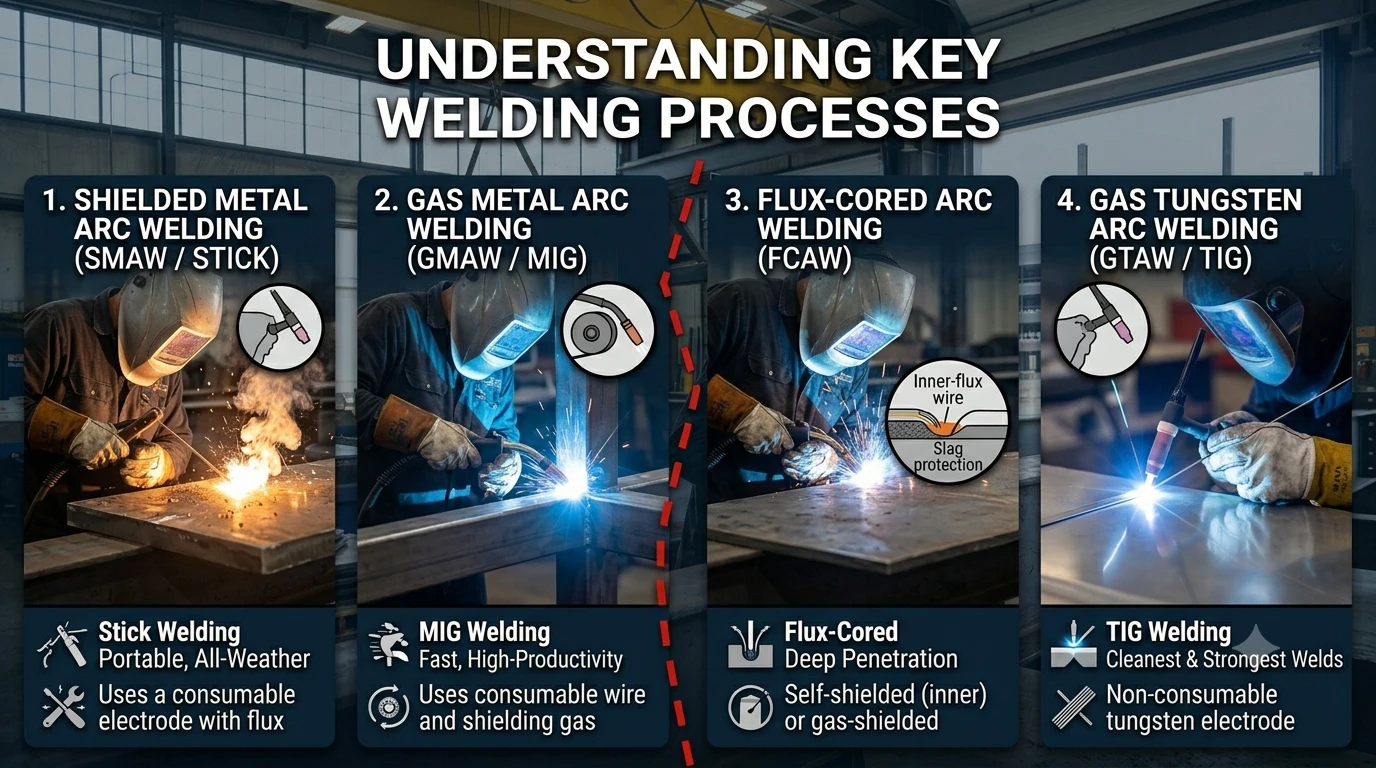
MIG Welding (Metal Inert Gas) is one of the most popular welding processes, known for its efficiency and versatility. This method utilizes a continuous solid wire electrode that is fed through a welding gun and melted to join two metal surfaces. MIG welding is ideal for both thin and thick materials, often used in automotive and fabrication industries due to its speed and ease of use. However, it requires a clean surface for effective adhesion and is less effective in windy conditions.
TIG Welding (Tungsten Inert Gas) offers precision and control, making it suitable for thin materials and intricate designs. This process uses a non-consumable tungsten electrode and an inert gas to protect the molten weld pool from contamination. TIG welding is widely employed in aerospace and automotive manufacturing, appreciated for its strength and quality of welds. Nevertheless, it can be slower than MIG welding and requires a higher skill level.
Stick Welding, or Shielded Metal Arc Welding (SMAW), is distinguished by its simplicity and portability. In this method, an electrode coated in flux is used to create the arc, which subsequently melts by the heat generated during the process. Stick welding is favored in outdoor applications and for repairs due to its adaptability and effectiveness on rusty or dirty surfaces. However, it may produce less aesthetically pleasing welds compared to MIG or TIG.
Additional welding processes, such as Flux-Cored Arc Welding (FCAW) and Submerged Arc Welding (SAW), further broaden the landscape of welding techniques, catering to different industrial requirements. Each method presents unique advantages and disadvantages, emphasizing the importance of selecting the appropriate welding process based on the project specifications.
Specialized Welding Techniques
Welding, as a fundamental part of many industrial processes, encompasses a variety of techniques tailored to specific applications. While general welding methods like MIG and TIG are widely employed, the industry also relies on specialized welding techniques to solve niche problems effectively. Three notable methods include submerged arc welding, plasma arc welding, and laser welding.
Submerged arc welding (SAW) is distinguished by its ability to produce deep weld penetration and a high welding speed. This process is often utilized in the manufacturing of heavy steel structures due to its efficiency in joining thick materials. During submerged arc welding, a granular flux covers the weld pool, reducing harmful fumes and providing excellent protection against oxidation. Industries such as shipbuilding and pipeline construction frequently adopt this technique for its reliability and quality.
Another specialized method is plasma arc welding (PAW), which operates by creating a plasma arc between a tungsten electrode and the workpiece. This technique offers greater precision compared to conventional arc welding, making it suitable for welding thin materials and intricate components. The high-temperature plasma arc allows for a focused heat source, which is beneficial in applications such as aerospace and electronics, where control over weld characteristics is crucial.
Lastly, laser welding employs focused laser beams to join materials with remarkable accuracy and minimal heat input. This method is particularly advantageous for delicate applications, as it minimizes the heat-affected zone, reducing the risk of structural changes in adjacent areas. Laser welding is increasingly utilized in automotive manufacturing and medical device production due to its speed and precision, enabling manufacturers to achieve high-quality seams in complex geometries.
In summary, specialized welding techniques such as submerged arc welding, plasma arc welding, and laser welding serve critical roles in specific industries. Each method presents unique benefits and applications, making it essential to choose the right process based on material properties and project requirements.
Conclusion and Future Trends in Welding
In summary, the selection of the appropriate welding process is crucial for addressing specific project requirements, significantly affecting both the quality and efficiency of the final product. As has been detailed above, the various types of welding processes—such as MIG, TIG, and stick welding—each have unique advantages that cater to different applications, materials, and environments. Understanding these factors allows professionals to make informed decisions that enhance productivity and ensure safety in welding practices.
Looking ahead, the welding industry is poised for significant advancements. One of the most prominent trends is the increasing integration of automation in welding processes. Automated welding systems not only improve precision and speed but also reduce the exposure of human welders to hazardous conditions. The rise of robotics in welding applications is reshaping the landscape, allowing for more consistent and high-quality welds.
Furthermore, advancements in welding materials are transforming the field. With the ongoing research and development of high-performance alloys and composite materials, welders are now equipped to work with a broader range of metals, thus expanding the scope of projects that can be undertaken. These materials often exhibit enhanced properties, such as increased strength and improved corrosion resistance, making them ideal for demanding applications.
As we move forward, it is evident that the welding industry will continue to evolve, shaped by innovative technologies and materials. Professionals in the field must stay abreast of these trends to maintain competitiveness and operational excellence. Embracing new methodologies and practices will not only ensure enhanced performance but also contribute to more sustainable welding practices in the future.