
Aluminum Welding: Challenges and Solutions

Understanding Aluminum’s Unique Properties
Aluminum is a versatile metal characterized by a range of unique properties that both facilitate and complicate the welding process. One of its most notable features is its lightweight nature, which makes aluminum an attractive option for numerous applications, especially in industries such as aerospace and automotive. This low density provides significant benefits in terms of weight reduction without compromising structural integrity, thereby enhancing fuel efficiency and performance.
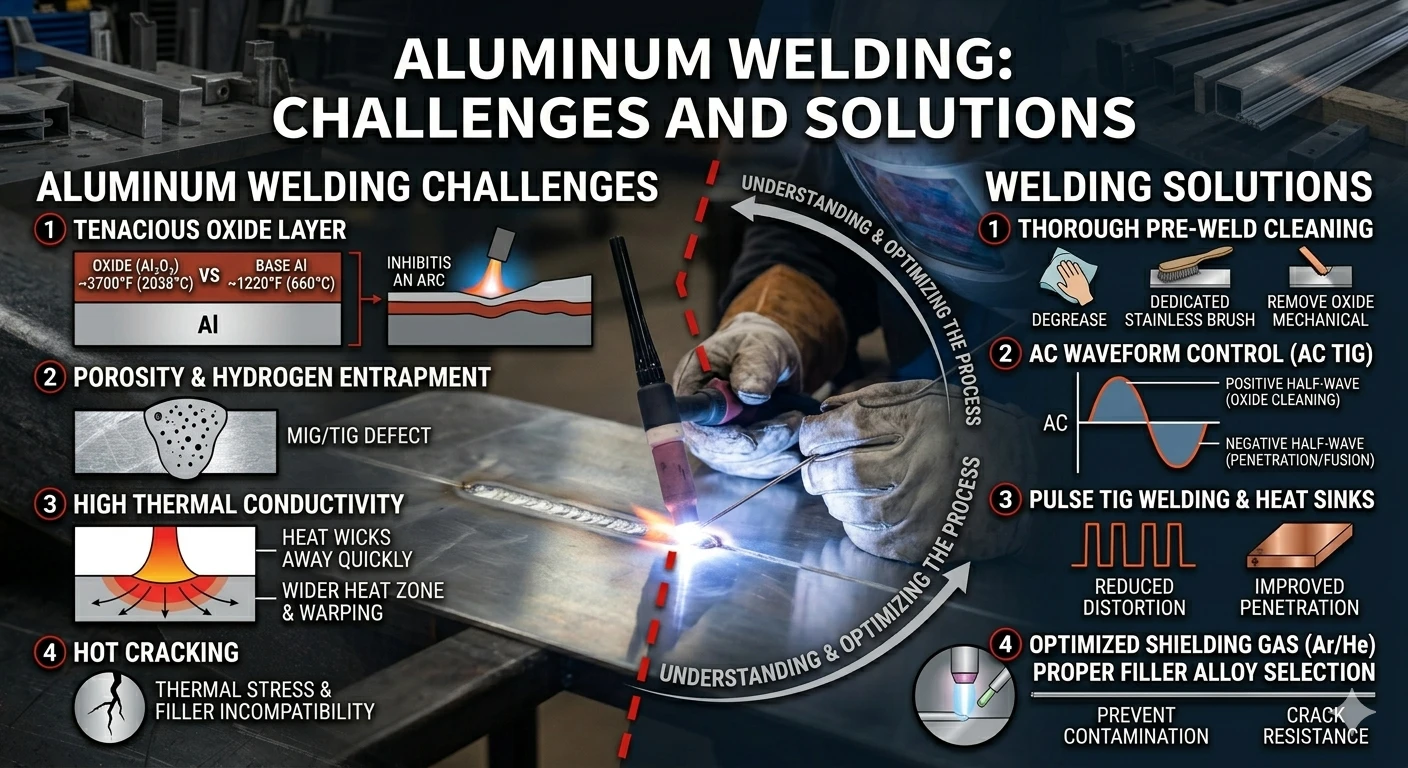
Additionally, aluminum exhibits excellent resistance to corrosion due to the formation of a natural oxide layer. This property is advantageous as it prolongs the lifespan of aluminum components. However, this oxide layer poses a significant challenge during the welding process, as it can inhibit proper fusion between welded pieces unless adequately addressed. Effective surface preparation techniques, such as mechanical cleaning or chemical treatments, are vital to ensure successful welding outcomes.
Another critical characteristic of aluminum is its high thermal and electrical conductivity. These features enable efficient heat dissipation, which is particularly important when working with aluminum in high-temperature environments. However, this property can also lead to challenges during welding, as the heat generated is quickly dissipated, requiring careful control of welding parameters. This necessitates the use of specific welding techniques, such as TIG (Tungsten Inert Gas) or MIG (Metal Inert Gas) welding, which are better suited for aluminum compared to traditional methods.
Diverse aluminum alloys, such as 6061 and 7075, each present unique welding challenges and solutions. The varying compositions of these alloys influence their mechanical properties and suitability for different applications. Understanding these aspects is crucial for selecting the appropriate welding technique and securing the desired performance outcomes in fabrication processes.
Common Challenges in Aluminum Welding
Aluminum welding presents a distinct set of challenges that can affect the integrity and durability of the finished product. One of the primary challenges is porosity, which occurs when gas bubbles become trapped within the weld. This condition is often the result of moisture, oil, or dirt present on the surface of the aluminum prior to welding. Contaminants interfere with the melting process and can create voids that weaken the weld. Careful surface preparation is paramount to reduce the risk of porosity. Welders must ensure that the aluminum components are clean and free from any impurities.
Another significant challenge is cracking, particularly hot cracking, which can occur during the cooling phase of the weld. This phenomenon is influenced by several factors, including the welding parameters, such as heat input, filler material selection, and the cooling rate. For instance, excessive heat can exacerbate the issue, leading to structural weaknesses in the weld. It is crucial for welders to monitor their techniques and possibly adjust their methods to mitigate the risk of cracking.
Contamination also plays a pivotal role in the challenges associated with aluminum welding. Aluminum is highly reactive, which means that oxidation can quickly occur on its surface when exposed to air. This oxide layer can hinder the welding arc and compromise the weld quality. Effective strategies for preventing contamination include utilizing argon shielding gas and employing proper pre-weld cleaning techniques. Moreover, the choice of welding process, such as GTAW or GMAW, can impact the susceptibility to these challenges, as each method has its operational peculiarities.
Understanding these common challenges—porosity, cracking, and contamination—is essential for welders working with aluminum. Addressing these issues proactively through thorough preparation and skilled execution can lead to stronger, more reliable welds.
Best Practices and Techniques for Successful Aluminum Welding
Aluminum welding presents unique challenges due to the metal’s properties, such as its tendency to oxidize and its high thermal conductivity. To achieve high-quality welds, it is essential to adopt best practices tailored specifically for aluminum. One of the foundational steps is to ensure thorough surface preparation. Aluminum surfaces must be clean and free of contaminants such as grease, oil, or oxidation. A stainless-steel brush or a chemical cleaner can be used to prepare the surface effectively, enhancing the bond in the weld.
Choosing the right filler material is another critical aspect. When welding aluminum, it is important to select a filler that closely matches the base material in terms of strength and thermal properties. Common filler metals, such as 4047 and 5356, are typically used depending on the specific alloy being welded. Understanding the compatibility of the filler material with the aluminum alloy ensures optimal strength and corrosion resistance in the weld.
The selection of the welding process, whether Tungsten Inert Gas (TIG) or Metal Inert Gas (MIG), also plays a crucial role. TIG welding offers greater precision and control, making it suitable for thin materials and intricate projects, while MIG welding generally yields higher deposition rates, making it ideal for thicker sections. Whichever method is chosen, controlling variables like heat input and travel speed is vital. Excessive heat can lead to distortion or burn-through, while too rapid a travel speed can result in weak welds or incomplete fusion. Therefore, consistent monitoring and adjustment during the welding process are necessary to ensure high-quality outcomes.
Innovative Solutions and Advances in Aluminum Welding Technology
The field of aluminum welding continues to evolve, driven by the relentless pursuit of improved efficiency and quality outcomes. One notable area of advancement is the development of automated welding systems, which have significantly transformed the aluminum welding landscape. Automation facilitates consistency and precision while alleviating the burden of manual labor. As these systems become increasingly sophisticated, robotics integrated with artificial intelligence are deployed to handle complex welding tasks that were once challenging for human welders.
In addition to automation, the progress in alloy development plays a critical role in enhancing aluminum welding practices. Researchers and manufacturers are focusing on creating new aluminum alloys that exhibit better weldability, reduced susceptibility to defects such as cracking, and improved heat resistance. These advancements not only streamline the welding process but also contribute to the overall durability of finished products. The implementation of such advanced materials has, in many instances, allowed for thinner sections to be welded effectively, expanding applications in industries such as automotive and aerospace.
Moreover, the introduction of innovative welding techniques, such as laser welding and friction stir welding, has shown promise in overcoming some of the traditional challenges associated with aluminum welding. Laser welding, for example, offers concentrated energy delivery, resulting in tighter heat-affected zones and minimal distortion. Meanwhile, friction stir welding, a solid-state process, reduces the risk of defects and produces clean welds without melting the base material. These methods highlight the ongoing research efforts aimed at fine-tuning and optimizing aluminum welding processes.
Looking towards the future, the trend is clear: the integration of smart technologies and materials in aluminum welding is set to revolutionize traditional practices. This evolution will likely enhance efficiency, boost productivity, and improve the overall quality of welds, solidifying aluminum’s position as a preferred material across diverse applications.